
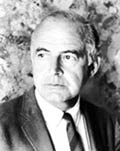

9th March 1910 --- 23rd January 1981
Samual Barber (born 1910, West Chester, Pa., U.S.--died 1981, New York, N.Y.), composer who is considered one of the most expressive representatives of the lyric and romantic trends in musical composition in the United States.
Barber studied the piano from an early age and soon began to compose. In 1924 he entered the Curtis Institute of Music in Philadelphia, where, in addition to piano and composition, he studied singing and conducting. After graduation in 1934, Barber devoted himself entirely to composition. He developed a distinctive style, absorbing some technical procedures of modern music but without indulging in experimentation for its own sake. He established his reputation with his overture to The School for Scandal (1933), based on Sheridan's comedy by that name, and with Music for a Scene from Shelley (1935), inspired by the poet Percy Bysshe Shelley's Prometheus Unbound.
Although many of Barber's works make literary allusions, his music is not programmatic in the strict sense. Significant in this respect are the two Essays for Orchestra (1938, 1942), which are intended as musical counterparts of the literary form. Structural considerations govern Barber's instrumental writing; there is great astringency in harmony, but the basic tonality remains secure; the rhythmic lines are very strong, without loss of coherence.
In 1936 Barber composed his String Quartet, the slow movement of which, arranged for string orchestra, was performed under the title Adagio for Strings by the NBC Symphony Orchestra under Arturo Toscanini in 1938 and acquired extraordinary popularity both in the United States and in Europe.
Barber's First Symphony (1936; revised, 1942) is in the Romantic tradition. In the Second Symphony (1944; revised, 1947), commissioned by the U.S. Army Air Forces (which he had joined in 1943), Barber introduced an electronic instrument imitating radio signals for air navigation, replaced in the revised version by an E-flat clarinet.
Barber also wrote a Violin Concerto (1941) and a Cello Concerto (1946). His Piano Sonata (1949) is the most ambitious work in this form by an American composer. Other compositions are Dover Beach, for voice and string quartet (1931); three vocal works with orchestra, Knoxville: Summer of 1915 (1948), Prayers of Kierkegaard (1954), and Andromache's Farewell (1962); Medea (1947); and the opera Vanessa, produced by the Metropolitan Opera Association, New York City, in 1958, which was awarded a Pulitzer Prize.
Barber's Piano Concerto (1962) brought him new international success and another Pulitzer Prize (1963). His opera Antony and Cleopatra opened the new auditorium of the Metropolitan Opera Association at the Lincoln Center for the Performing Arts in 1966. After a period of creative inactivity, Barber resumed composing for orchestra. The Lovers and Fadograph of a Yestern Scene were first performed in 1971 and Third Essay for Orchestra had its premiere in 1980.
Copyright 1994-1998 Encyclopaedia Britannica
If you require any more info on Samuel Barber, then click here for Walter Simmons excellent site.
Last Updated on 19th July 2003
By Reg
And now for the Music

"Adagio for Strings, string quartet in B minor, opus 11", Sequenced by Bjorn Lengton.
(1814) Violin Concerto 1st Mov a beautiful piece Sequenced by David Siu
(444) Violin Concerto 3rd Mov a excellent midi Sequenced by David Siu
(1813) "Reincarnations" Sequenced by Ted Clark
(1809) "Excursions No.1". Sequenced by E.P.Grant
(1810)"Excursions No.2". Sequenced by E.P.Grant
(1811)"Excursions No.3". Sequenced by E.P.Grant
(1812)"Excursions No.4". Sequenced by E.P.Grant

If your interest's match mine or you would like to send in your Classical style compositions in midi file format then please E-mail me
atclassicalmidi (@) gothere . uk . (com) please remove all spaces and brackets to get to my email address, fight against spam.
Back to Classical Midi Main Menu click
HERE
