
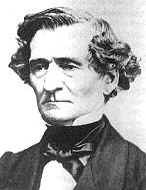
HECTOR BERLIOZ

1803 --- 1869

Hector Berlioz had a curious and indeed a tragic career, He was an innovator, and he was never understood. His operas were kept off the stage by Wagner's music dramas, while his symphonies and his religious works suffered under the double misfortune of difficulty and eccentricity. He made, himself enemies all along the line. As a student, he was wayward, pugnacious, and cursed with that sardonic humour which makes foes among fools. He did not reverence his professors at the Conservatoire, and he had a poor opinion of contemporary French and Italian composers.

Open enemies and secret ill-wishers surrounded him on every hand. He said many things that music had not said before; and he, and he alone, brought French music at a bound into line with all the new work that was being done elsewhere in poetry, in prose, and in art, but he threw away almost his last chance by the enormous demands he made upon -players and conductors. It is this which specially characterises Berlioz as a composer.
Big things, and particularly big, horrible things, had a fatal fascination for him. The ordinary orchestra, the ordinary chorus, the ordinary concert room, would never do for him; everything must be magnified, as it were, beyond life-size.

He once talked of an opera in which a wicked King was to arrange a burlesque of the Day of Judgment, only to have his performance interrupted by the real coming of Christ and the blast of angel trumpeters. He heard children singing in St. Paul's Cathedral, and had a vision of devils burlesquing the scene in hell.

His mind seemed steeped in horrors.

Wagner said of him: " He lies buried beneath the ruins of his own machines." Heine's estimate of him is well worth quoting :' A colossal nightingale, a lark the size of an eagle, such as once existed, they say, in the primitive world. Yes, the music of Berlioz in general has for me something primitive, almost antediluvian; it sets me dreaming of gigantic species of extinct animals, of mammoths, of fabulous empires with fabulous sins, of all kinds of impossibilities piled one on top of the other, these magic accents recall to us Babylon, the hanging gardens of Semiramis, the marvels of Nineveh, the audacious edifices of Mizraim.

After all, Belioz was one of the big men who compel not only admiration in what they archive, but sympathy in what they aim at and failed to compass.

His very exaggerations dispose one to like him, he was so desperately in earnest, and often where he fails he commands the respect due to an intrepid voyager in strange lands.
Hector Belioz was born at Cote St Andre in December 1803.
His father was a doctor and a opium eater, and the general opinion is that to the opium eating should be attributed much that was unbalanced and morbid in the son.
The father wanted him to be a doctor, but he rebelled. "Become a physician!" he cried; "study anatomy" dissect, take part in horrible operations No! No! that would be a total subversion of the natural course of my life." So, much against his parents' wishes, he went to Paris, and, amid many trials and privations, studied at the Con- servatoire.

Later on, like so many more composers, he went to Italy to complete his training. From Rome he was recalled in a very amusing way. It was almost a necessity of Berlioz's nature that he should be in love, and his passions were of such heat and fervour that they rarely failed to carry him beyond all bounds of reason.

It was so now. He heard that a frivolous and unscrupulous Parisian beauty, who had bled his not overfilled purse rather freely, was about to be married. The news should have given him joy, but, instead of that, it set up a spirit of revenge, and he hurried off to Paris with loaded pistols, not even waiting for passports.

He attempted to cross the frontier in women's clothes, and was arrested. A variety of contretemps occurred before he reached the capital, and by that time his rage had cooled and the pistols were thrown aside. The incident is thoroughly characteristic of Berlioz,

It was shortly after this that he saw a pretty Irish actress on the stage, and fell hopelessly in love with her. A romantic passion it was, and it dominated Berlioz's life. Harriet Smithson was playing Shakespeare, and for Berlioz she became a celestial divinity, a lovely ideal of art and beauty, a personification of the transcendent genius of the dramatist.

To win her for himself, became the end and aim of Berlioz's existence.
His first step was to give a concert, at great expense, at which he hoped she would be present. But, alas I the concert turned out a fiasco, and the adored one was not there. Berlioz was in utter despair. But luck was yet to favour him, and in a most unexpected way. Miss Smithson became involved in pecuniary difficulties, and, to make matters worse, she met with an accident which prevented her again appearing on the stage.
Now was the composer's chance. He had no great means of his own, yet he at once offered to pay all the lady's debts, and, of course, to marry her as well. She accepted him; but, alas with the marriage came the end of the romance. She who had once been an angel now turned out a shrew. She had a vile temper, was fretful and peevish, and by and by became obsessed by an ungovernable jealousy, for which there was no cause. At last, unable to endure the torture any longer, Berlioz arranged a separation, and to the end provided for her wants with scrupulous fidelity.

Two of Berlioz's greatest works--the Symphonie Fantastique and the Romeo and Juliet symphony--were directly inspired by his passion for Harriet Smithson. The first won him his wife. It also won him the handsome pecuniary reward of 20,000 francs, paid him out of sheer admiration by the weird, gaunt, demon fiddler Paganini,whose "dark flowing hair" Leigh Hunt sings.

He wrote in almost every branch of composition, but his skill lay in the marvellous way in which he developed the resources of the orchestra. In number of parts and instruments employed, his Requiem is the most ambitious score in existence.

Writing of his life in Paris in 1837, the late Sir Charles Halle gives this little sketch of Berlioz, then a young man of thirty-four: "There never lived a musician who adored his art more than did Berlioz; he was, indeed,'enthusiasm personified.' To hear him speak of, or rave about, a real chef-d euvre such as Armida, Iphigenie,or the C minor symphony, the pitch of his voice rising higher and higher as he talked, was worth any performance of the same.

And what a picture he was at the head of his orchestra, with his eagle face, his bushy hair, his air of command, and glowing with enthusiasm. He was the most perfect conductor I ever set eyes upon, one who held absolute sway over his troops, and played upon them as a pianist upon the keyboard."

For a genius of his rank, Berlioz had extraordinary limitations. He was no executant upon any instrument (for being able to strum a few chords on the guitar does not count), and he was painfully aware how much this was a hindrance to him and to his knowledge of musical literature, which indeed was limited. Halle was often astonished to.find that works familiar to every pianist were unknown to him--not merely works written for the piano, such as Beethoven's sonatas, of which he knew but few, but also orchestral works, oratorios, etc., known to pianists through arrangements

Perhaps many undoubted crudities in his work would have been eliminated had he been able to hear them before committing fhem to paper, for the eye alone was not sufficient to give him a clear idea of the effect of his musical combinations. Berlioz died in I869. He had married a second time, but he outlived his wife, and latterly had to be taken care of by his mother-in-law.

The above was written by Cuthbert Haddon in 1916.

Last Updated on 17th November 2003 by Reg

And now for the Music

I like to thank George Pollen for the following excellent crafted music, to contact George pleaseemail Goerge at (gpollen  @  polleng.freeserve.co.uk) just remove the brackets and spaces for the email address.

"The Shepherds bid farewell to the holy family from : L'Enfance du Christ", a beautiful piece. Sequenced by George Pollen.

(1109)"Symphony Harold in Italy for Viola and Orchestra Second Movement". Sequenced by Jason Plumlee

(1110)"Berlioz Symphony Harold in Italy for Viola and Orchestra Third Movement". Sequenced by Jason Plumlee

(1111)"Roman Carnival Overture, Op. 9", a beautiful piece. Sequencer Unknown. This is a large file please click here for pkunzip.

(1112)"March to the Scaffold", another beautiful piece. Sequenced by Andrew Anderson. This is a large file please click here for pkunzip.

(1113)"Un Bal" from the Symphonie Fantastique (Info kindley supplied by Barry). Sequencer Unknown. This is a large file please click here for pkunzip.

This page has been visited --
--


If your interest's match mine or you would like to send in your Classical style compositions in midi file format then please E-mail me at  

classicalmidi (@) gothere . uk . (com) please remove all spaces and brackets to get to my email address, fight against spam.

Back to Classical Midi Main Menu click HERE            

                                             BACK TO MY HOME PAGE Classical musical home page
