
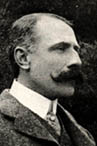
SIR EDWARD WILLIAM ELGAR

2nd June 1857 --- 23th February 1934

SIR EDWARD WILLIAM ELGAR (born 1857, Broadheath, Worcestershire, England--died 1934, Worcester, Worcestershire), English composer whose works in the orchestral idiom of late 19th-century Romanticism--characterized by bold tunes, striking colour effects, and mastery of large forms--stimulated a renaissance of English music.

The son of an organist and music dealer, Elgar left school at age 15 and worked briefly in a lawyer's office. He was an excellent violinist, played the bassoon, and spent periods as a bandmaster and church organist. He had no formal training in composition. After working in London (1889-91), he went to Malvern, Worcestershire, and began to establish a reputation as a composer. He produced several large choral works, notably the oratorio Lux Christi (1896; The Light of Life), before composing in 1896 the popular Enigma Variations for orchestra. The variations are based on the countermelody to an unheard theme, which Elgar said was a well-known tune he would not identify--hence the enigma. Repeated attempts to discover it have been unsuccessful. All but the last of the 14 variations refer cryptically to friends of Elgar, the exception being his own musical self-portrait. This work, highly esteemed by Hans Richter, who conducted the first performance in 1899, brought Elgar recognition as a leading composer and became his most frequently performed composition. In 1900 there followed another major work, the oratorio The Dream of Gerontius, which many consider his masterpiece. Based on a theme by John Henry Cardinal Newman, it dispensed with the traditional admixture of recitatives, arias, and choruses, using instead a continuous musical texture as in the musical dramas of Wagner. The work was not well received at its first performance in Birmingham, but after it was acclaimed in Germany, it won British favour.

Elgar, a Roman Catholic, planned to continue with a trilogy of religious oratorios, but he completed only two: The Apostles (1903) and The Kingdom (1906). In these less successful works, representative themes are interwoven in the manner of the leitmotivs of Wagner. Other vocal works include the choral cantata, Caractacus (1898), and the song cycle for contralto, Sea Pictures (1900).

In 1904 Elgar was knighted, and from 1905 to 1908 he was the University of Birmingham's first professor of music. During World War I he wrote occasional patriotic pieces. After the death of his wife in 1920, he curtailed his music writing severely, and in 1929 he returned to Worcestershire. Friendship with Bernard Shaw eventually stimulated Elgar to further composition, and at his death he left unfinished a third symphony, a 0iano concerto, and an opera.

Elgar's principal works of a programmatic nature are the overture Cockaigne, or In London Town (1901), and the "symphonic study" Falstaff (1913). Of his five Pomp and Circumstance marches (1901-07, 1930), the first became particularly famous. Also highly esteemed are his two symphonies (1908 and 1911), the Introduction and Allegro for strings (1905), and his Violin Concerto (1910) and Cello Concerto (1919).

The first English composer of international stature since Henry Purcell (1659-95), Elgar liberated his country's music from its insularity. He left to younger composers the rich harmonic resources of late Romanticism and stimulated the subsequent national school of English music. His own idiom was cosmopolitan, yet his interest in the oratorio is grounded in the English musical tradition. Especially in England, Elgar is esteemed both for his own music and for his role in heralding the 20th-century English musical renascence.

Copyright 1994-1998 Encyclopaedia Britannica

Last Updated on 17th May 2003
By Reg

And now for the Music

Please let James Pitt-Payne know your thoughts on this piece, contact James, Click Here. .

(3005)"Pleading" a lovely sequenced by James Pitt-Payne.

My thanks go to Edward Gold, for the beautifully sequeced pieces that follows. Email Edward Gold, and let him know what you think.

(2911)Symphony No. 2 in Eb, Op. 63 Mov.1. Allegro vivace e nobilmente (32channels) Roland GS format, a beautiful sequence by Edward Gold. This is a very large fileclick here for pkunzip

(2920)Symphony No. 2 , Op. 63, Mov.2. slow movement (32 channels) Roland GS format, another truly wonderful sequence by Edward Gold. This is a very large fileclick here for pkunzip

(2912)Symphony No. 2 , Op. 63, Mov.3. Rondo - presto (32 channels) Roland GS format, another truly wonderful sequence by Edward Gold. This is a very large fileclick here for pkunzip

(2913)Symphony No. 2 in Eb, Op. 63,Mov.4. Moderato e maestoso (32 channels) Roland GS format, a truly wonderful sequence by Edward Gold. This is a very large fileclick here for pkunzip

(2298)"Concert Overture In the South (Alassio), Op.50, 32 track version, another wonderful sequence by Edward Gold. This is a very large fileclick here for pkunzip

(2299)"Concert Overture In the South (Alassio), Op.50", 16 track version another wonderful sequence by Edward Gold. This is a very large fileclick here for pkunzip

(1247)"Symphony No. 1, Ab major, Op. 55" 1st movement: Andante(This the 16 track version) a wonderful sequence by Edward Gold. This is a very large fileclick here for pkunzip

(1236)"Symphony No. 1, Ab major, Op. 55" 1st movement: Andante(This the 32 track version)(resequenced 12/08/2000) a wonderful sequence by Edward Gold.

(1739)"Symphony No.1, Ab major, Opus.55" second (Allegro molto) and third movements,(Adagio)(This the 16 track version) a really lovely piece, sequenced by Edward Gold.

(1499)"Symphony No.1, Ab major, Opus.55" second (Allegro molto ) and third movements,(Adagio)(this is the 32 track version,resequenced 12/08/2000) a really lovely piece, sequenced by Edward Gold.

(1745)"Symphony No. 1, Ab major, Op. 55" last movement: Andante(This the 16 track version)another wonderful sequence by Edward Gold.

(1612)"Symphony No. 1, Ab major, Op. 55" last movement: Andante(This the 32 track version)(resequenced 12/08/2000) a wonderful sequence by Edward Gold. This is a very large fileclick here for pkunzip

(748)"Cockaigne Overture" (In London Town) op. 40(This the 16 track version) beautifully sequence by Edward Gold. This is a very large fileclick here for pkunzip.

(749)"Cockaigne Overture" (In London Town) op. 40(This the 32 track version) beautifully sequence by Edward Gold. This is a very large fileclick here for pkunzip.

Edward Elgar,(27)  Imperial March Seq by Robert Finley

(1177)"Imperial March Op. 32" a lovely piece. Sequencer Goerge Pollen. This is a large fileclick here for pkunzip.

Elgar,(64) Pomp and Circumstance March No.4 Seq by Robert Finley

Elgar,(75) Sursum Corda Seq by Ralph Van Zetten

I am very grateful to Edward Gold for donating the following music, a great deal of effort went into producing this excellent piece!

(487) "Enigma" Variations" (orchestral)Please note this is new updated version (20/11/99)of the 16 track version, beautifully sequence by Edward Gold. This is a very large fileclick here for pkunzip.

(487a) "Enigma" Variations" (orchestral)Please note this is new updated version (20/11/99)of the 32 track version, beautifully sequence by Edward Gold. This is a very large fileclick here for pkunzip.

This page has been visited--
FastCounter by bCentral


If your interest's match mine or you would like to send in your Classical style compositions in midi file format then please E-mail me at  

classicalmidi (@) gothere . uk . (com) please remove all spaces and brackets to get to my email address, fight against spam.

Back to Classical Midi Main Menu click HERE            

                                             BACK TO MY HOME PAGE Classical musical home page
