
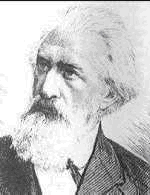
FRIEDRICH VON FLOTOW

My thanks go to Victor Roy for the picture..

27thApril 1812 --- 24thJanuary 1883

Although one of the most brilliant operatic composers of his day, it is a curious fact that less attention has been paid by the biographers of the period to Friedrich von Flotow than to many minor and less gifted musicians.

Even in modern books, dealing with great composers of the past and present, the space allotted to Flotow is disappointingly meagre, one is able, therefore to glean but very little of the life of this great composer.

Perhaps, to a certain extent, Friedrich Flotow had only himself to blame. It is said of him that he was shy and reticent. Interviewers who came to seek out details of his private life would leave his house with empty notebooks, but did they ask his veiws on the latest opera, or on any subject appertaining to his beloved art, he was eloquent to the point of loquacity.

Born on April 27th, 1812, on the estate Rentendorf, in Mecklenburg, Freiherr Von Friedrich Flotow was the son of a landed nobleman, and as such was the fortunate possessor of the many advantages that wealth, and a doting parent, could provide.

His father intended that Friedrich should enter the diplomatic service, and the boy was educated with that end in view.

At the age of fifteen he was sent to Paris to continue his studies. Operatic music at that time had reached high pitch of perfection, with Meyerbeer as its chief exponent.
Already a keen student of music, the brilliant artistic life into which he was thrown brought Flotow to a recognition of his own talent for composition, and with the consent of his father, he placed himself in the hands of Reicha.
His musical training continued for three years, but in 1830 the Revolution drove him back to Germany. He returned to Paris in 1835, and remained until the Revolution in March, 1845, when again he returned to his father's estate at Mecklenburg.

Paris attracted him as steel to a magnet, and only when living in its brilliant atmoshere could he produce his best work. He was always a prominent figure in the salons of the rich, and at the private house of a noble French family he produced his first Operatic work, " Stradella."

This was subsequently produced at the Palais Royal in 1837. The records do not reveal the nature of its reception, but in 1844 it was rewritten, and in that year it enjoyed remarkable success in Germany.
Curiously enough, when produced two years later in London, it proved a dead failure, at Convent Garden it ran for only two nights!

Undaunted by the varying fortunes of "Stradella", Flotow produced a number of other works, one of which, " Le Naufrage de la Meduse," swept him immediately into the front rank of contemporary composers.

It was presented as many as fifty-three times in a single year. Six years later it was rewritten by the author, and under the title of " Die Matrosen," was played successfully at nearly every theatre in Germany.

The events that led to the composition Flotow's greatest work, "Martha," form an interesting story. During his second stay in Paris, Flotow was approached by the manager of a famous opera house, and asked to write the first act of a new ballet, "Harriette, ou la Servante de Greenwiche." The ballet was to be written specially for Adele Dumilatre, a great dancer of that day, who had commissioned the manager to give out the work to three different composers so that the ballet could be produced almost immediately. The second act was allotted to Robert Mergmuller, and the third to Edouard Deldevez.

Upon this ballet, which was written and produced in the space of a few days, was based the opera which brought lasting fame to its creator. The title chosen was " Martha," a work of superlative merit which is as popular to-day as in 1844, the year it was first produced.

Those who do not know the history of "Martha" are apt to wonder at its freshness, vivacity and sprightly charmqualities that one does not usually expect from the pen of a German composer, but, apart from the fact that "Martha" is essentially French, written in the first instance for a French dancer and a French audience, one must remember that Flotow loved Paris no less than his native Mecklenburg, and the gay, lively atmosphere of the French capital pervaded all his works.

There was no doubting the success of "Martha" when it was first produced in Venice in 1847. The audience was wildly enthusiastic, and the fame of Flotow from that moment was established. It was subsequently produced at Covent Garden, London, the Theatre Lyrique, Paris, as well as in New York and New Orleans. It is now recognised as one of the world's greatest operatic works, and in this country, the title-role has been played by such famous singers as Nilsson, Patti, Gerster, Kellogg, Parepa Rosa and Scmbrich, and the part of Lionel by Campanini and Caruso.

Although all Flotow's works are distinguished by their freshness of melody and cheerfulness of character, "Stradella " and "Martha"are generally considered to take the leading position. Indeed, his later productions were deemed by some critics to be mere "diluted editions" of the two already mentioned. Certainly they did not achieve conspicuous success.

He died at Darmstadt, January 24th I883, leaving the uncompleted manuscript of a new opera, " Rosella."

The above was written by Bernard Brice in the early 1920's

Last Updated on 28th October 2000

And now for the Music

(1775)"Selection from Martha". Sequenced by Reginald Steven Ritchie

This page has been visited --
--


If your interest's match mine or you would like to send in your Classical style compositions in midi file format then please E-mail me at  

classicalmidi (@) gothere . uk . (com) please remove all spaces and brackets to get to my email address, fight against spam.

Back to Classical Midi Main Menu click HERE            

                                             BACK TO MY HOME PAGE Classical musical home page
